Decolonising Therapy
When Therapy Becomes Propaganda

On a crisp November morning in Philadelphia last year, clinicians from across the U.S. gathered for the annual conference of the International Society for the Improvement and Teaching of Dialectical Behaviour Therapy (ISITDBT), an event typically devoted to evidence-based approaches for treating suicidal ideation, emotional dysregulation, and trauma.
Instead, one workshop, delivered by Dr Nathalie Edmond, a clinical psychologist and diversity consultant, opened with a slide pairing “Zionism” with “fascism” on a continuum labelled Acceptable Discourse. Another slide - drawing on visual materials produced by the activist organisation Slow Factory - displayed “The Colonized Mind,” placing Zionism alongside “rape culture,” “genocidal tendencies,” “internalised racism,” and “homophobia.” This was not framed as personal political opinion, but as part of a therapeutic worldview, one in which a certain political identity was implicitly medicalized.
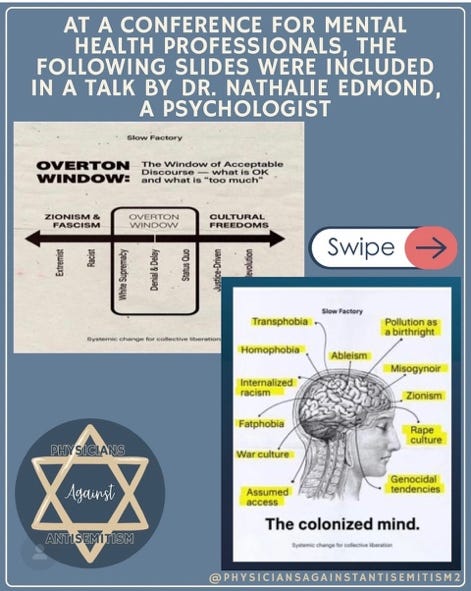
The reaction was swift. Critics accused Edmond of importing antisemitic tropes into a clinical setting. In a subsequent video response, she defended her approach as aligned with anti-racist practice, characterising the backlash as a “modern-day digital lynching” and describing Zionism, across its religious and political forms, as an expression of colonialism. These events raise an important question for our cultural moment: what happens when therapy ceases to be a space of open-ended exploration and becomes a vehicle for ideological interpretation?
“Decolonizing therapy” sits within a broader Critical Social Justice (CSJ) movement that applies an oppressed/oppressor framework - drawing on postcolonial theory and critical race theory - to psychological practice. Dr. Jennifer Mullan, founder of the Decolonizing Therapy movement and author of ‘Decolonizing Therapy’, argues that therapy is inherently political and that it operates within “a colonial, outdated, Eurocentric, misogynistic, ableist, heterosexist and classist paradigm.”
At its best, this movement emerges from legitimate concerns. Historically, aspects of psychology have reflected cultural bias, pathologised minority experiences, and insufficiently accounted for systemic inequality. Efforts to expand cultural competence, acknowledge systemic contributors to distress, and make therapy more inclusive are both necessary and overdue. However, when this corrective becomes totalising, a new problem emerges. If therapy is understood primarily as a political project, the risk is that we longer have simply critique, but replacement: one overarching framework substituted for another. In such models, the complexity of individual experience can be flattened into predefined narratives of oppression and privilege.
It is important to acknowledge that all therapeutic approaches operate within some form of conceptual framework. Psychoanalysis, cognitive behavioural therapy, and humanistic models each carry assumptions about how the mind works and how change occurs. Therapy has never been entirely neutral in the sense of being framework-free. The question, therefore, is not whether interpretation occurs, but how it functions.
Across professional codes (such as those of the American Psychological Association, British Association for Counselling and Psychotherapy; and Australian Psychological Society), therapists are not expected to be value-free, but they are expected to avoid imposing their personal beliefs onto clients. In practice, this means maintaining a form of procedural neutrality: working within the client’s values and meaning-making, rather than directing them toward predetermined conclusions.
When activism is imported wholesale into therapy, this balance can shift. The clinical lens may move from understanding distress to evaluating beliefs through an ideological framework. In this model, some political alignment risk becoming informal diagnostic categories. A client is no longer simply anxious, grieving, or traumatised; they may instead be interpreted as embodying “internalized oppression,” “colonised thinking,” or “privileged identity.” The focus subtly moves from what the client is experiencing to what the therapist believes those experiences represent.
Interpreting a client’s beliefs and experiences has always been part of therapeutic practice. Psychoanalytic traditions, for example, routinely explore unconscious motivations and internal conflicts. Therapy has never been a framework-free enterprise. The distinction, however, lies in how meaning is arrived at. In most therapeutic models, meaning is developed through collaborative exploration, a process in which interpretations are tentative, revisable, and guided by the client’s own sense-making. By contrast, more prescriptive approaches risk introducing predefined interpretations, in which certain beliefs are treated as inherently symptomatic or in need of correction. The concern, then, is not that therapists interpret, but that interpretation may shift from an open, dialogical process to one in which conclusions are effectively imposed rather than discovered. This shift often follows a recognisable pattern.
First, particular beliefs are reinterpreted as evidence of psychological distortion; for example, as “internalised oppression” or a “colonised mind.” As Brazilian liberation pedagogue, Paulo Freire (1921-1997) wrote:
“The oppressed, having internalised the image of the oppressor and adopted his guidelines, are fearful of freedom.”
Within this framing, disagreement with certain political positions is not understood not as genuine conviction, but as a symptom of ideological conditioning.
Second, these beliefs are framed as harmful to mental health. Frantz Fanon’s call to identify and “remove” the psychological residue of colonialism is reinterpreted in therapeutic terms: political nonconformity becomes a wound requiring intervention.
Finally, therapy itself becomes the mechanism of change, not simply exploring the client’s worldview, but reshaping it. While change is a legitimate aim of therapy, the key question is who determines its direction. Clients often seek therapy because something in their thinking or emotional life is causing distress. In most models, change emerges through collaborative exploration. In more prescriptive frameworks, however, change may be guided toward alignment with a predefined interpretation of social reality. The distinction is subtle but important: between facilitating insight and directing belief.
For clients, the consequences are not abstract. They may include:
Self-censorship within sessions
Loss of trust in the therapist
Therapeutic rupture or early termination
Identity confusion or fragmentation
Such dynamics may also function as barriers to access, discouraging individuals from seeking or continuing therapy if they feel their worldview will be judged or reinterpreted through a fixed lens. These are not merely theoretical concerns, but potential real world clinical outcomes.
This whole framework has clear intellectual roots in Paulo Freire’s critical pedagogy, which reimagined education as a political act. Teachers were tasked not simply with transmitting knowledge, but with helping students recognize and reject oppressive worldviews. In educational contexts, this approach has been influential and, in some cases, transformative. But when it is transferred into therapy, its implications shift. The therapist is no longer only facilitating exploration, but guiding the client toward a particular form of “awareness”.
The structure in therapy is similar to that used in education:
Identity is filtered through an oppressor/oppressed lens
Disagreement is reframed as false consciousness
Progress is measured by alignment with a particular framework
In education, this shifts learning into activism. In therapy, it risks transforming care into correction.
While the examples above centre on Zionism and post-October 7 discourse, the underlying dynamic is not confined to one issue. Similar patterns can be observed across a range of contemporary movements:
In race-informed approaches influenced by BLM, distress may be primarily framed through systemic oppression, at the expense of individual complexity.
In debates around gender identity, tensions have emerged between exploratory therapy and models that prioritise affirmation, with disagreement often framed as harm.
In post-#MeToo contexts, there is a tendency to apply prescriptive frameworks to interpersonal experiences, potentially narrowing interpretative space.
Across these domains, the issue is not the presence of values, but the degree of interpretive flexibility afforded to the client. What distinguishes more explicitly ideological frameworks is that they may link psychological health to alignment with particular social or political interpretations, thereby narrowing the range of acceptable meanings a client can arrive at.
History offers cautionary examples of what can happen when mental health practice aligns too closely with dominant ideologies. In the Soviet Union, for example, dissidents were sometimes diagnosed with “sluggish schizophrenia,” a condition used to justify confinement by recasting political dissent as pathology.
Contemporary activist-informed therapy is clearly not equivalent in severity or intent. However, the structural logic bears reflection: when disagreement with a dominant framework is interpreted as dysfunction, the boundary between care and control begins to blur. At the heart of therapy lies a commitment to respect for autonomy, dignity, and pluralism. Carl Rogers’ principle of unconditional positive regard emphasises meeting the client without judgment, regardless of their beliefs. When therapists define certain identities or viewpoints as inherently pathological, this principle is undermined. Empathy can become conditional, extended more readily to those who align with the therapist’s framework, and withheld from those who do not.
This raises a paradox. Movements that aim to “decolonize” therapy may, in practice, risk a different form of colonisation: the imposition of the therapist’s worldview onto the client’s inner life. Mental health equity requires that all clients, regardless of race, gender, religion, or political belief, have access to safe, non-judgmental care. When ideological frameworks shape clinical interpretation, this neutrality is compromised. Certain identities may be implicitly validated, while others are problematised. Some forms of distress are foregrounded; others are minimised or reframed. The result is not greater inclusion, but a hierarchy of empathy, one that may discourage those in “disfavoured” categories from seeking care at all.
In the wake of polarising global events, including the Israel–Hamas conflict, these dynamics take on immediate significance. For some Jewish clients, for example, aspects of their identity may be reframed within therapy as expressions of colonialism rather than sources of meaning, safety, or belonging.
None of this implies that therapists must suspend moral judgment entirely or affirm all beliefs uncritically. Therapists routinely work with clients whose thoughts or actions raise ethical concerns. The task, however, is to distinguish between understanding a client’s internal world and endorsing their beliefs or behaviours.
Unconditional positive regard does not require agreement; it requires that the client be treated as a person worthy of understanding, rather than as a problem to be ideologically corrected. In moments of vulnerability, the question becomes not only can I access therapy, but will I be understood within it? Therapy does not need to be apolitical to be ethical. But it must remain client-led, pluralistic, and grounded in open inquiry rather than predetermined conclusions.
This means:
Recognising social context without reducing the individual to it
Exploring beliefs without pre-classifying them
Supporting autonomy rather than directing it
Maintaining a space where multiple worldviews can be held without judgement
The therapy room is not a space without structure or interpretation. But it is one in which those structures should remain responsive to the client, rather than anchored to fixed ideological conclusions.
The events at the DBT conference should be remembered not as an anomaly, but as a signal: a reminder of how easily the boundaries of therapy can shift. If those boundaries are not carefully maintained, the risk is not only that therapy becomes ideological, but that, in doing so, it loses the very conditions that make healing possible.
This is a grave breach of all of mental health codes of ethics.
I was already considering writing about therapeutic frameworks, their epistemologies and their disputable effects on patients, but this is just crazy levels of political activism and pseudoscience disguised as psychological care. How can you pretend to be a therapist and have worked and yourself and be so incoherent and intolerant? It’s insane.